November 25, 2026
Commercial Property Valuation in Texas: How Much Is Your Property Worth?
If you own commercial real estate in Texas, you have probably wondered what your property is actually worth. Maybe you're considering selling, refinancing, bringing in an investor, or simply reviewing the performance of an asset you've held for years.
Determining commercial property value in Texas is not always as simple as looking at nearby listings or calculating a price per square foot.
Unlike residential real estate, commercial property values depend heavily on the income a property generates, the quality of its tenants, lease terms, operating expenses, location, condition, and current market demand.
A retail center in Austin, an industrial warehouse in Georgetown, and an office building in Round Rock may all require different valuation considerations, even if they have similar square footage.
Understanding how to value commercial real estate can help property owners set realistic expectations, identify opportunities to increase value, and make more informed decisions about selling, holding, or improving their investment.
How Is Commercial Property Value Determined?
Commercial real estate is generally valued using three primary approaches: the income approach, sales comparison approach, and cost approach.
The appropriate method depends on the property type, available market data, and how the property is used.
For income-producing properties such as office buildings, retail centers, industrial properties, and multifamily assets, the income approach is often especially important because investors focus on the property's ability to generate revenue.
For owner-user buildings or properties with limited rental income, comparable sales and replacement costs may carry more weight.
A reliable commercial property valuation in Texas typically considers multiple factors rather than relying on one calculation.
1. The Income Approach: Using Net Operating Income to Estimate Value
One of the most common ways to estimate the value of income-producing commercial property is through net operating income, or NOI.
Net operating income is the property's annual operating revenue minus its operating expenses, before debt service and income taxes.
Revenue may include rental income, certain tenant reimbursements, parking income, and other property-related income. Operating expenses generally include items such as property taxes, insurance, management, maintenance, repairs, and other expenses that the owner is responsible for paying.
NOI does not typically deduct mortgage payments, depreciation, income taxes, or major capital expenditures.
How to Calculate Net Operating Income
Consider a commercial property with the following annual income and expenses:
| Item | Annual Amount |
|---|---|
| Rental and other property income | $240,000 |
| Vacancy and collection allowance | -$12,000 |
| Property taxes | -$30,000 |
| Insurance | -$12,000 |
| Maintenance and repairs | -$15,000 |
| Property management and other expenses | -$21,000 |
| Net Operating Income | $150,000 |
In this example, the property generates $150,000 in annual NOI. That number provides a starting point for estimating value using a capitalization rate.
These figures are illustrative and do not represent a specific property or market average.
2. Cap Rates: How Investors Calculate Commercial Property Value
A capitalization rate, commonly called a cap rate, measures the relationship between a commercial property's net operating income and its value.
Cap rates are frequently used to compare income-producing properties and evaluate investment risk.
The basic valuation formula is:
Commercial Property Value = Net Operating Income ÷ Cap Rate
For example, assume a property generates $150,000 in annual NOI and comparable investment properties support a 6% cap rate.
$150,000 ÷ 0.06 = $2,500,000
Based on that simplified calculation, the property's estimated value would be $2.5 million.
However, a different cap rate can produce a significantly different valuation.
| Cap Rate | Estimated Property Value |
|---|---|
| 5% | $3,000,000 |
| 6% | $2,500,000 |
| 7% | $2,142,857 |
| 8% | $1,875,000 |
Illustrative values using $150,000 in annual NOI. Actual market cap rates depend on property type, location, lease structure, risk, and other factors.
As the example shows, even a small change in the cap rate can meaningfully affect the estimated value.
What Is a Good Cap Rate for Commercial Property?
There is no single cap rate that is considered good for every commercial property.
A lower cap rate often reflects a property perceived as having more stable income, stronger tenant quality, a desirable location, or lower investment risk. A higher cap rate may indicate greater risk, less certainty around income, or the potential for a higher initial return.
For example, a newer industrial property leased long-term to a financially strong tenant may trade at a different cap rate than an older office building with multiple vacancies and near-term lease expirations.
When evaluating commercial property in Austin or Central Texas, the most meaningful cap rate comparisons come from similar properties in comparable locations with similar income and risk characteristics.
3. Comparable Sales: What Are Similar Commercial Properties Selling For?
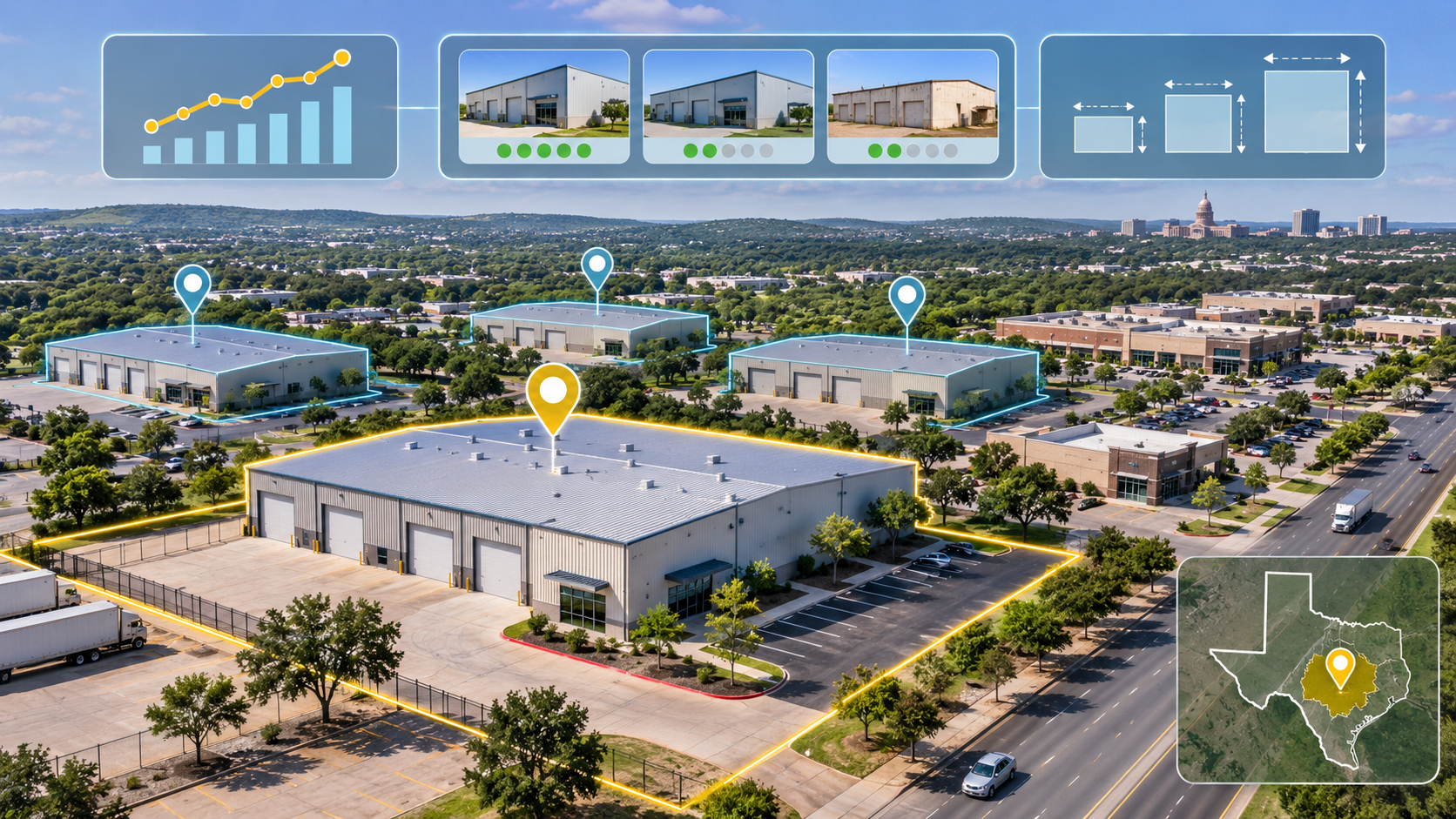
The sales comparison approach estimates property value by reviewing recent sales of similar commercial properties.
This method is especially useful for owner-user properties, vacant buildings, commercial land, and assets where reliable rental income may not be available.
A commercial real estate professional may compare recent sales based on location, building size, property type, age, condition, occupancy, parking, access, and other features.
For example, if similar industrial properties in a particular Central Texas submarket have recently sold for approximately $175 to $200 per square foot, those transactions may help establish a preliminary value range for another industrial building.
However, commercial properties are rarely identical.
A warehouse with modern loading docks, adequate power, higher clear heights, and functional truck access may command a different price than an older warehouse of similar size that lacks those features.
Comparable sales provide valuable market evidence, but they need to be adjusted for differences between properties.
4. Price Per Square Foot: A Useful Starting Point, Not the Full Picture
Price per square foot is one of the simplest metrics used in commercial property valuation.
The formula is:
Price Per Square Foot = Property Price ÷ Building Square Footage
For example, a 20,000-square-foot industrial building priced at $4 million has an asking price of $200 per square foot.
This metric can help buyers and sellers compare properties quickly, especially when evaluating buildings of similar type and function.
However, price per square foot does not account for everything that affects value.
A fully leased retail property with strong tenants may be worth more per square foot than a similar vacant building. An industrial property with extra yard space, high-capacity power, or specialized improvements may also command a premium.
When evaluating commercial real estate prices in Austin and Central Texas, price per square foot should be used alongside income, lease quality, property condition, and market demand.
5. The Cost Approach: What Would It Cost to Replace the Property?
The cost approach estimates value by considering the cost to construct a building with similar utility, subtracting depreciation, and adding the value of the land.
This method can be useful for newer buildings, owner-user facilities, specialized properties, or situations where comparable sales and income data are limited.
For example, an industrial facility with specialized power infrastructure, heavy-duty construction, or unique improvements may require a closer examination of replacement costs.
However, construction cost does not automatically equal market value.
A building may have been expensive to construct, but its market value still depends on location, demand, functionality, and what buyers are willing to pay.
Location: Why Central Texas Submarkets Affect Property Value
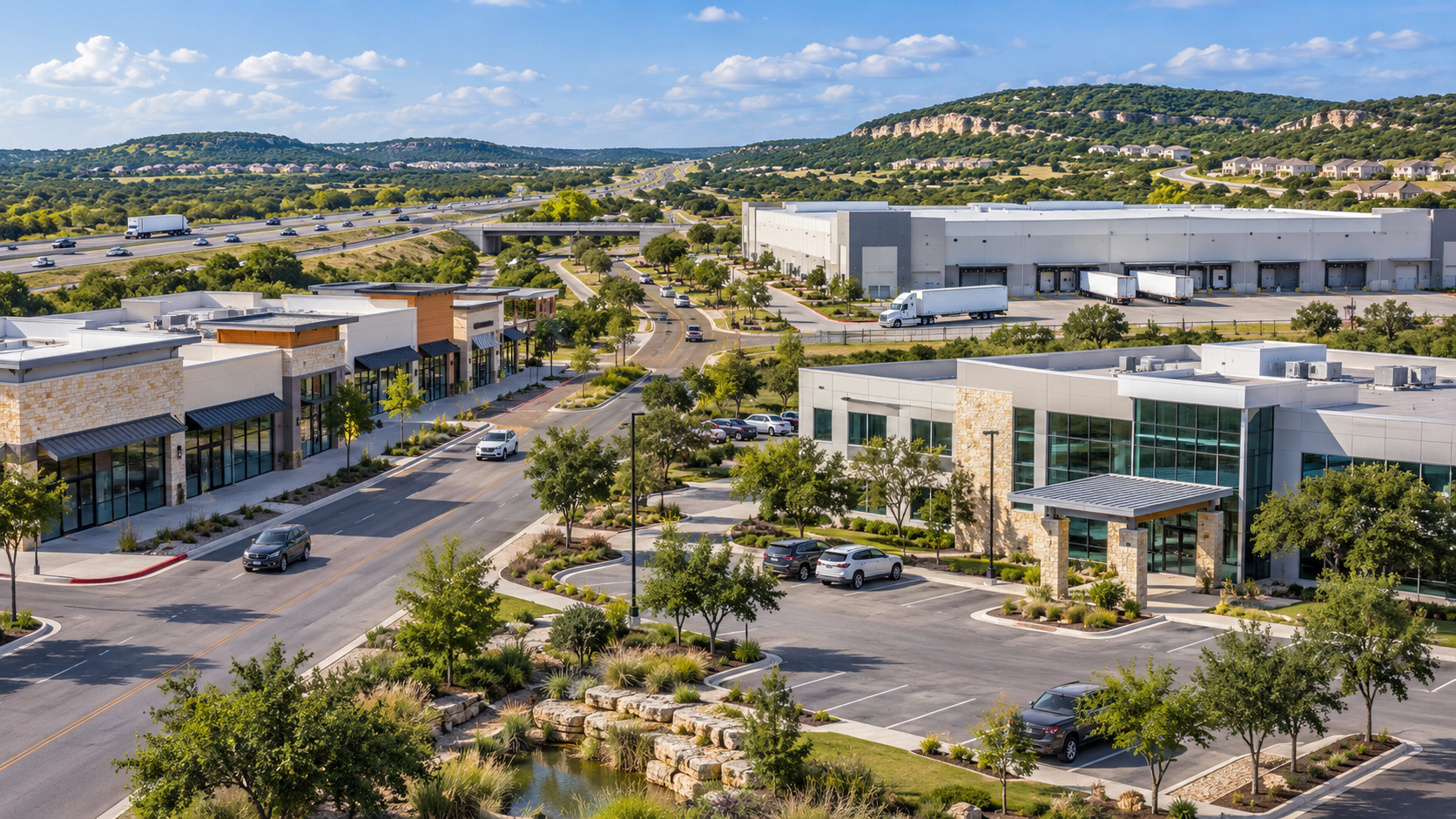
Location remains one of the strongest drivers of commercial property value. However, location means different things for different commercial property types.
For retail properties, visibility, traffic counts, customer demographics, and access can strongly influence value. Industrial users may prioritize highway connections, truck circulation, power availability, loading, and proximity to customers or suppliers.
Office and medical properties may be more sensitive to parking, accessibility, nearby employment, surrounding amenities, and tenant demand.
Across Central Texas, property owners should consider the characteristics of their specific submarket rather than relying on Austin-area averages.
For example, commercial property values in Austin, Round Rock, Georgetown, Pflugerville, Hutto, Taylor, Kyle, Buda, and San Marcos can be influenced by different growth patterns, transportation routes, available inventory, and tenant needs. A property positioned near a major employment center or growing residential area may attract a different buyer pool than a similar property in a less established location.
Tenant Quality and Lease Terms Can Significantly Affect Value
For income-producing commercial properties, the tenants and their leases are often just as important as the physical building.
Investors want to understand whether rental income is stable, how long tenants are committed to the property, and what expenses the landlord may need to absorb.
A building leased to financially stable tenants with predictable income may be more attractive than a similar property with frequent turnover or near-term vacancies.
Lease terms can also affect valuation.
For example, a property with several years remaining on a lease may offer more income certainty than one where a major tenant's lease expires in six months. Rent escalations, renewal options, tenant improvement obligations, and operating expense reimbursements can also influence value.
Investors may pay a premium for predictable income, but they will also consider whether existing rents are above or below current market levels.
A property with below-market rents may offer future upside, while a property with above-market rents could face income risk when leases expire.
Property Condition and Deferred Maintenance
A commercial property's physical condition can directly affect what buyers are willing to pay.
Older buildings are not necessarily less valuable, particularly when they occupy strong locations or offer features that are difficult to replace. However, deferred maintenance and required capital improvements can reduce buyer interest or create pressure on the sale price.
A buyer may evaluate the condition of the roof, HVAC systems, electrical infrastructure, plumbing, parking lot, building exterior, foundation, and other major components.
For industrial properties, loading doors, clear height, power capacity, truck courts, and yard conditions may also influence value.
For office, retail, and medical properties, interior layouts, accessibility, common areas, and tenant improvements can be important.
Before selling, property owners should understand which improvements are likely to support value and which may not provide a worthwhile return.
How Commercial Property Taxes Affect Market Value
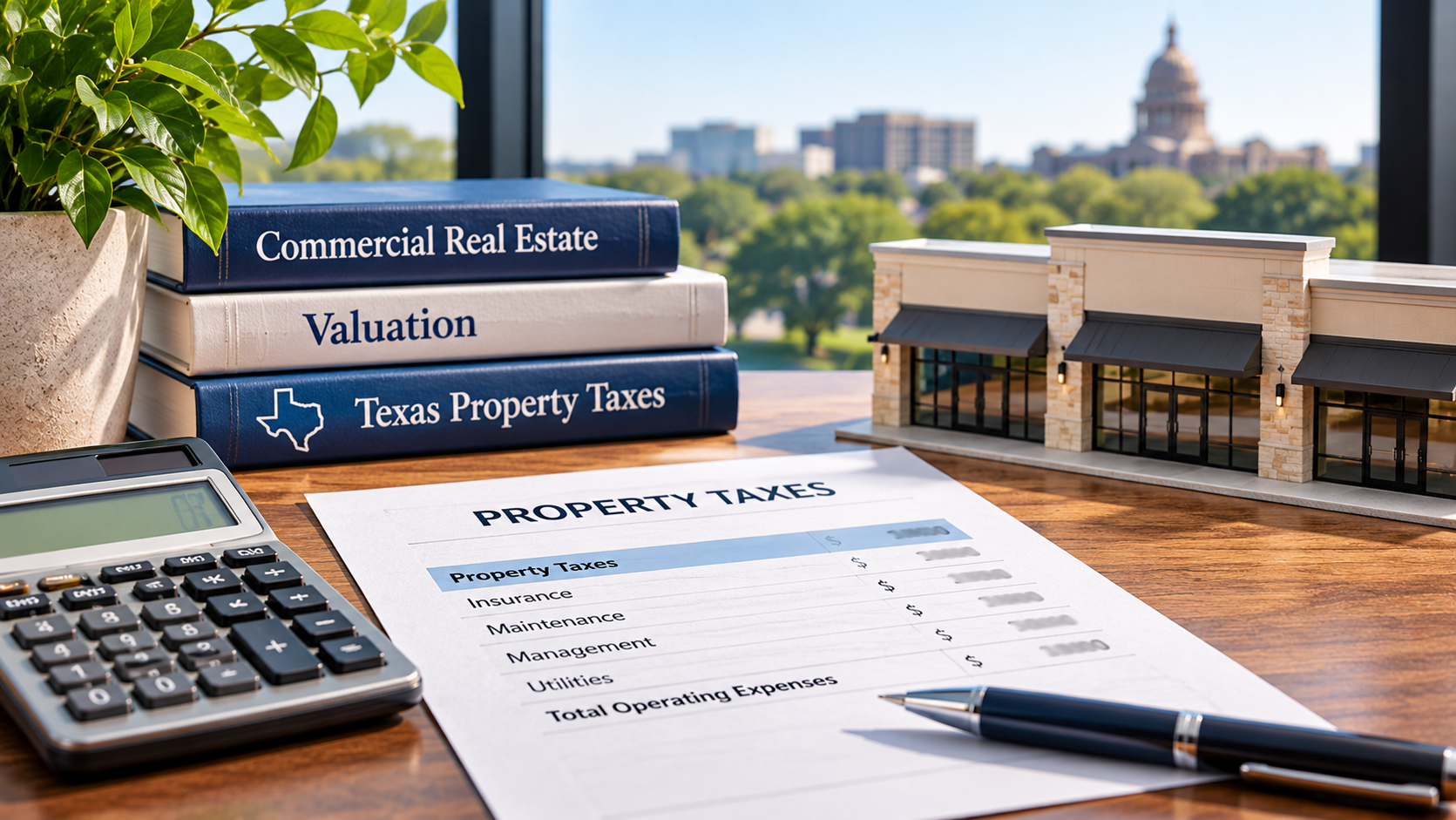
Property taxes are another important consideration in commercial property valuation in Texas.
Texas commercial property owners are subject to local property taxes, which can represent a significant portion of annual operating expenses.
For income-producing properties, higher property taxes can reduce NOI when those costs are not fully reimbursed by tenants. Lower NOI may reduce the property's value under the income approach.
Owners should also understand that the value assigned by a county appraisal district for property tax purposes is not necessarily the same as the amount a buyer would pay in a current market transaction.
Texas appraisal districts generally appraise taxable property at market value as of January 1, but their assessments serve a different purpose than an individual property's sale-price analysis.
When considering a sale, owners should review current market conditions and comparable transactions rather than relying only on the appraisal district's valuation.
Can a Commercial Property Value Calculator Tell You What Your Building Is Worth?
Online commercial property value calculators can provide a quick preliminary estimate, particularly when the property's NOI and an appropriate market cap rate are known. However, a calculator cannot fully evaluate the details that make one property more valuable than another.
A basic calculator may not account for upcoming lease expirations, tenant credit, deferred maintenance, environmental concerns, zoning restrictions, future capital improvements, or unique property features.
The cap rate entered into the calculator also needs to reflect comparable investment properties. Using the wrong cap rate can produce a misleading valuation.
For owners asking, "How much is my commercial property worth?", an online calculation is best treated as a starting point, not a substitute for a thorough market analysis or professional appraisal.
How Do Investors Evaluate Commercial Property Value?
Commercial real estate investors typically look beyond the current asking price. They evaluate how the asset performs today, what it may require in future expenses, and how the property could perform over their intended holding period.
For income-producing properties, investors may examine current NOI, vacancy, tenant quality, lease expirations, operating expenses, projected rent growth, and future capital requirements.
They may also consider financing costs, cash flow, debt service coverage, and potential resale value. For value-add opportunities, investors often evaluate whether improvements, new tenants, lease restructuring, or operational changes could increase the property's income and overall value.
For example, a property with vacant space may have a lower current value than a fully leased comparable property, but an investor may see upside if the vacancy can be filled at market rents.
That opportunity comes with additional risk, including leasing costs, tenant improvements, downtime, and uncertainty about future demand.
The most successful commercial real estate decisions consider both the property's current performance and the realistic cost of achieving future value.
What Factors Can Increase Commercial Property Value?
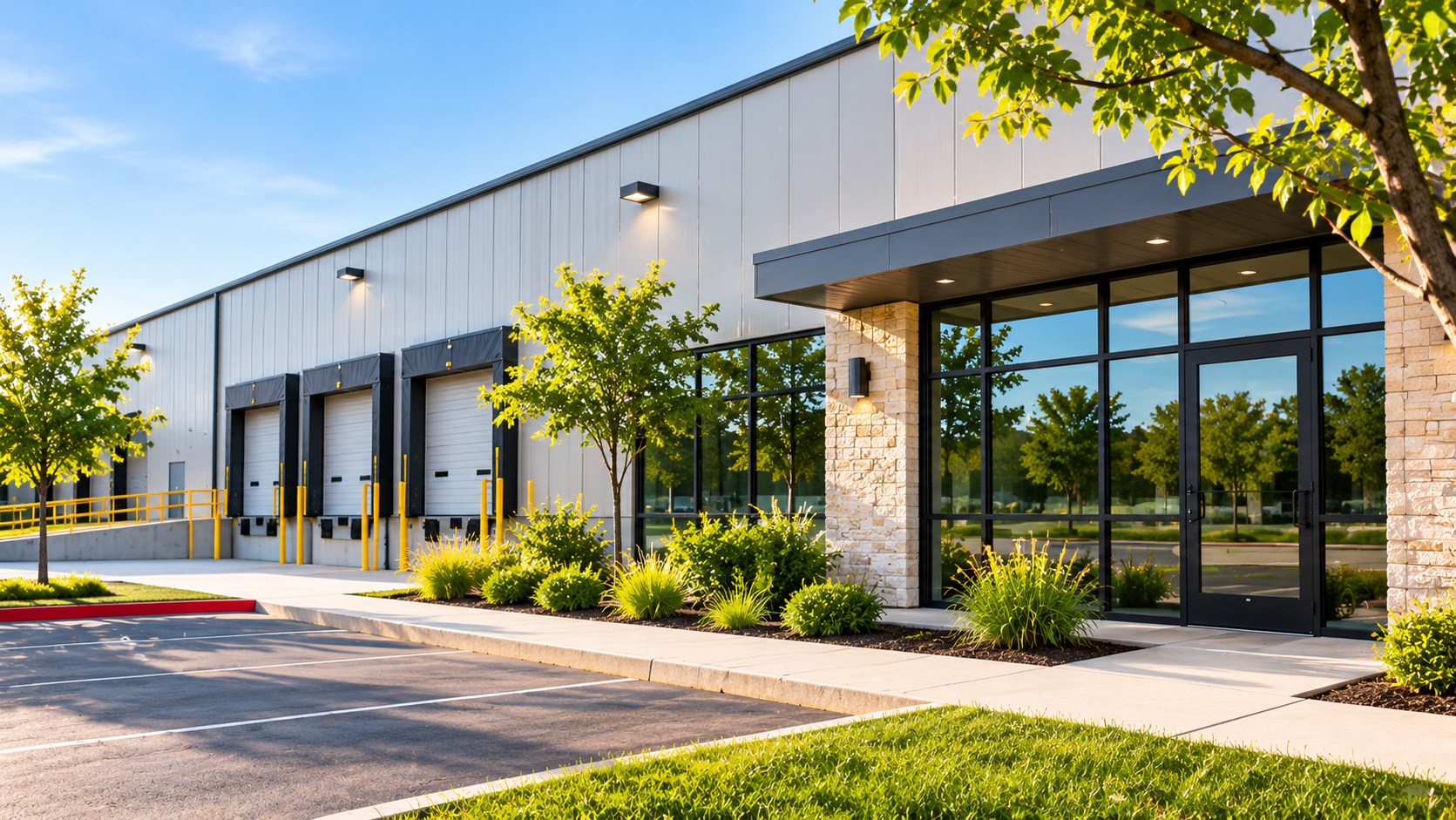
Property owners looking to improve commercial real estate value should focus on changes that strengthen income, reduce risk, or make the property more attractive to future buyers.
Depending on the property, this may include improving occupancy, addressing deferred maintenance, securing longer-term leases, reducing unnecessary operating expenses, or making improvements that support tenant demand.
For industrial properties, better loading access, functional yard space, or upgraded power may improve marketability. Retail properties may benefit from stronger tenant mix, improved access, or more attractive common areas. Office properties may benefit from modernization, flexible layouts, and better amenities.
However, improvements should be evaluated carefully. Spending more money on a property does not automatically increase its market value by the same amount. The goal is to make improvements that the market will recognize and that support the property's long-term income and usability.
When Should You Get a Commercial Property Valuation?
Property owners may benefit from reviewing their property's value before making a major financial or investment decision.
Common situations include preparing to sell, refinancing, evaluating a partnership buyout, planning capital improvements, reviewing an investment portfolio, or considering whether to hold or reposition an asset.
A property owner may also want an updated valuation after changes in occupancy, rental income, operating expenses, or local market conditions.
For those considering a sale, a commercial real estate market analysis can help establish a realistic pricing strategy based on current demand, comparable sales, income, and property-specific characteristics.
A formal appraisal may be necessary for financing, legal, or other purposes and should be completed by an appropriately credentialed appraiser when required.
Frequently Asked Questions About Commercial Property Valuation in Texas
How do you calculate the value of commercial real estate?
Commercial property value is commonly estimated using the income approach, sales comparison approach, or cost approach. For an income-producing property, a common calculation is annual net operating income divided by an appropriate market capitalization rate.
What is a good cap rate for commercial property?
A good cap rate depends on property type, location, tenant stability, market conditions, and investment risk. Lower cap rates often reflect properties with stronger income stability, while higher cap rates may indicate additional risk or greater potential initial returns.
How much is my commercial property worth?
Your property's value depends on its income, location, condition, lease terms, tenant quality, comparable sales, and current market demand. A commercial real estate market analysis or professional appraisal can provide a more reliable estimate than an online calculator alone.
What factors increase commercial property value?
Factors that can increase commercial property value include stronger rental income, reliable tenants, favorable lease terms, desirable location, improved property condition, functional infrastructure, and reduced investment risk.
Is commercial property value based on income or square footage?
Both may be relevant. Income-producing commercial properties are often evaluated primarily using income and cap rates, while price per square foot and comparable sales can be especially useful for owner-user properties, vacant buildings, and commercial land.
Is a Texas county appraisal district value the same as market value?
Not necessarily. County appraisal districts estimate property values for taxation as of January 1. A property's current sale price may differ based on market conditions, income, lease terms, property condition, and buyer demand.
How often should commercial property owners review their property's value?
Owners should consider reviewing value when market conditions change significantly or when making important decisions about selling, refinancing, improving, or repositioning a property.
The Bottom Line
Determining the value of commercial real estate in Texas requires more than reviewing an asking price or calculating a price per square foot.
Net operating income, cap rates, comparable sales, property condition, location, tenant quality, lease terms, and current market demand all play a role in what a commercial property may be worth.
For property owners, understanding these factors can help establish realistic expectations and identify opportunities before deciding whether to sell, refinance, hold, or improve an asset.
CIP helps commercial property owners, buyers, and investors evaluate real estate opportunities throughout Austin and Central Texas. Whether you own an office building, retail center, industrial property, warehouse, or development site, our team can help you assess current market conditions, review comparable properties, and develop a strategy aligned with your real estate goals.
Wondering what your commercial property is worth? Contact a CIP commercial real estate expert today to discuss your property and explore your options.
REQUEST YOUR CONSULTATION