Utility Capacity in Central Texas
Land in Central Texas can look great on paper.
The location may be strong. The growth trends may be obvious. The
zoning or ETJ status may seem workable. The price may even feel like an opportunity.
But before a buyer, developer, or investor gets too far into a deal, one question needs to be answered early:
Can the site actually support the intended project?
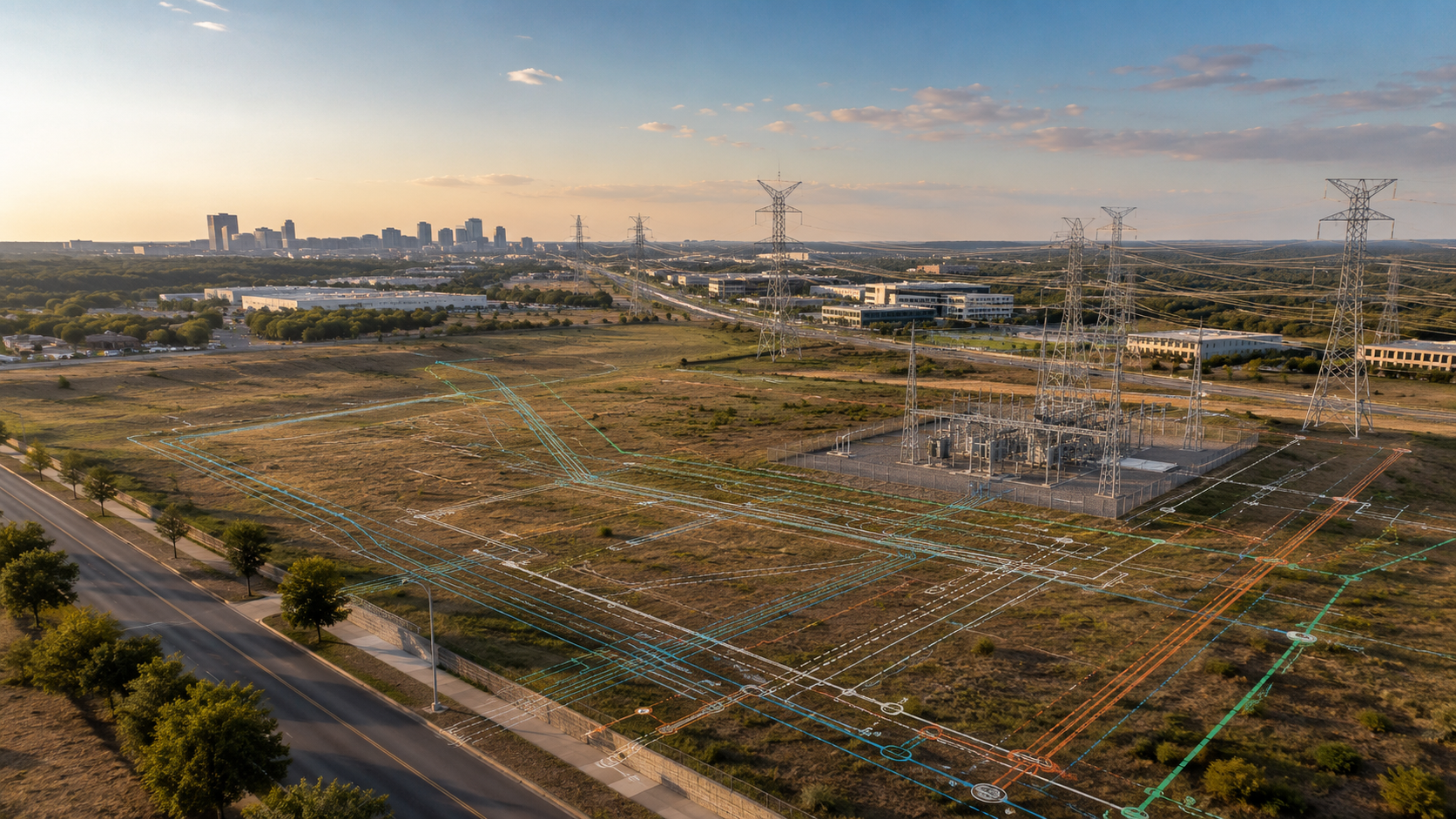
Utility capacity is one of the most important parts of commercial land due diligence, and it is also one of the easiest to underestimate. Water, wastewater, electric service, drainage, access, and off-site infrastructure can all impact whether a project is feasible, how long it will take, and how much it will cost.
In fast-growing Central Texas markets, utility availability can be the difference between a strong development opportunity and a property that becomes expensive to hold, redesign, or walk away from.
Why Utility Capacity Matters in Central Texas Land Development
Central Texas continues to attract developers, investors, industrial users, data centers, retailers, and residential growth. That growth creates demand for land, but it also
puts pressure on existing infrastructure.
A property may be located in a high-growth corridor, but that does not automatically mean the site has adequate utility service available today.
In many cases, buyers discover after going under contract that the site has limitations involving:
For commercial real estate investors, utility capacity should not be treated as a small technical detail. It should be part of the initial
feasibility review.
What Utilities Should You Check Before Buying Commercial Land in Texas?
Before purchasing commercial land in Texas, buyers should review the major utilities and infrastructure systems that will support the intended use.
The most important items to evaluate include:
Water Availability
Water service is one of the first items to confirm. Buyers should determine who provides water to the property, whether service is currently available, and whether the existing system has enough capacity for the proposed development.
A small commercial building, industrial user, retail center, restaurant, multifamily project, and data center may all have very different water needs.
Important questions include:
- Is there an existing water line near the property?
- What size is the line?
- Is there enough pressure and flow?
- Will the project require fire suppression?
- Are upgrades or extensions needed?
- Is the property served by a city, water district, MUD, private provider, or well?
A site may technically have water nearby, but that does not always mean the available service is sufficient for the intended project.
Wastewater Capacity
If public wastewater is available, the buyer should confirm capacity, connection points, distance to the line, and whether any off-site extension is required. If public wastewater is not available, the project may need to rely on septic or another on-site solution, which can limit density or certain types of uses.
For many commercial projects, wastewater limitations can have a major effect on site planning.
Important questions include:
- Is public sewer available?
- Where is the nearest connection point?
- Does the system have available capacity?
- Will lift stations or line extensions be required?
- Can the site support an on-site wastewater solution if needed?
- Will wastewater limitations reduce the intensity of the project?
Wastewater constraints can be especially important for restaurants, medical users, industrial facilities, multifamily projects, and other uses with higher demand.
Electric Service and Power Availability
Electric capacity is becoming a larger issue in commercial site selection, especially for power-heavy users. Data centers, advanced manufacturing, cold storage, industrial facilities, and large commercial users may require significantly more power than a typical site can immediately support.
This is especially relevant in Texas, where large-load demand has increased sharply due to data center activity and other major development projects.
ERCOT has received large volumes of requests for future power capacity, with data centers representing a major share of that demand.
For some projects, the issue is not just whether power exists nearby. The larger question is whether the site can be energized within the project’s required timeline.
Important questions include:
- Who is the electric provider?
- What voltage and capacity are available?
- How close is the nearest substation?
- Will new lines, transformers, or upgrades be required?
- What is the estimated timeline for service?
- Are there peak demand or reliability concerns?
- Will the project require backup power or behind-the-meter solutions?
Across the country, “time to power” has become a major site-selection issue for data centers and other energy-intensive users. In Texas, some data center developers have explored behind-the-meter power generation as a way to bridge grid connection delays.
Even for smaller commercial projects, electric service should be reviewed early so buyers are not surprised by cost, timing, or capacity limitations.
Stormwater and Drainage
Drainage is often overlooked during early land review, but it can have a major impact on site layout, usable acreage, and development cost.
A property may appear large enough for a project, but detention requirements, floodplain issues, drainage easements, or downstream capacity limitations can reduce the amount of buildable land.
Important questions include:
- Is any portion of the property in a floodplain?
- Are there existing drainage easements?
- Will the project require detention or water quality controls?
- Are there downstream drainage limitations?
- Will grading be complicated by topography?
- How much usable acreage remains after drainage requirements?
Drainage issues can also affect access, building placement, parking, and construction cost.
Access and Road Improvements
Utilities are not the only infrastructure issue that can impact development. Road access can also become a major constraint.
A property may have frontage, but that does not automatically mean it has approved access for the intended use. Driveway spacing, turn lanes, traffic studies, shared access easements, and road improvement requirements can all affect feasibility.
Important questions include:
- Does the property have legal access?
- Is access adequate for the proposed use?
- Are turn lanes or deceleration lanes required?
- Will a traffic impact analysis be needed?
- Are there TxDOT, county, or city requirements?
- Will off-site road improvements be required?
For retail, industrial, and mixed-use projects, access can be just as important as visibility.
What Is a Utility Availability Letter?
A utility availability letter is a document from a utility provider or public entity that helps confirm whether utility service may be available to a property.
Depending on the provider and location, the letter may address water, wastewater, or other services. It may identify whether service exists, whether capacity is available, and whether improvements may be required.
However, buyers should understand that a utility availability letter is not always a final guarantee of service. It is one part of the due diligence process.
A
strong due diligence review may also require conversations with utility providers, engineers, municipalities, districts, and other agencies involved in the development process.
How Utility Capacity Affects Land Value
Utility capacity can directly affect land value because it influences what can be built, how quickly it can be built, and how much it will cost to develop.
Two properties in the same market may have very different values if one has nearby utility capacity and the other requires major extensions or upgrades.
A site with strong infrastructure may command a premium because it can reduce risk and shorten the development timeline. A site with limited utilities may still have value, but buyers need to price that risk appropriately.
Utility issues can affect value by influencing:
- Development timeline
- Project density
- Construction cost
- Financing risk
- Tenant interest
- Exit value
- Holding costs
- Highest and best use
In some cases, utility limitations do not kill a deal. They simply need to be understood early enough to structure the purchase price, contract terms, due diligence period, and development plan accordingly.
Utility Due Diligence Checklist for Central Texas Land Buyers
Before buying commercial land in Central Texas, buyers should consider reviewing the following:
- Who provides water, wastewater, electric, gas, and telecom service?
- Are utilities currently available at or near the site?
- Is there enough capacity for the intended use?
- Are utility extensions required?
- Are off-site improvements required?
- What are the estimated connection costs?
- What are the expected timelines for service?
- Are easements needed?
- Are there drainage or floodplain issues?
- Does the site have legal and practical access?
- Are there road improvement requirements?
- Are there city, county, ETJ, district, or TxDOT approvals involved?
- Does the intended use match what the infrastructure can support?
The earlier these questions are answered, the easier it is to evaluate the true opportunity.
The Bottom Line
In Central Texas, land demand remains strong, but not every site is ready for development.
A property may have the right location, strong demographics, and attractive pricing, but utility capacity can still create major challenges. Water, wastewater, power, drainage, and access should all be reviewed early in the due diligence process.
For buyers, developers, and investors, the goal is not just to find land. The goal is to find land that can actually support the intended project.
CIP helps clients evaluate commercial land opportunities throughout Central Texas with a practical understanding of development feasibility, site constraints, market demand, and long-term value.
Whether you are evaluating land for retail, industrial, mixed-use, data center, or investment use, identifying utility and infrastructure issues early can help protect your investment and keep the project moving forward.
Get in touch with one of our experts today!