September 9, 2026

Commercial Property Taxes in Texas
For anyone buying commercial property in Texas, the number on the contract is only the starting point. The ongoing tax burden can change how a deal performs, how ownership costs are projected, and whether the investment still makes sense after closing.
That is why buyers should treat property tax due diligence as a core part of the acquisition process. Property taxes can affect investors, developers, and owner-users differently, but in every case, they influence the true cost of ownership.
When evaluating commercial property taxes in Texas, buyers should look closely at assessed value, tax districts, exemptions, rollback taxes, reassessment risk, special assessments, and the impact taxes may have on the pro forma.
Why Property Taxes Deserve Attention Early
Texas does not collect a state property tax. Property taxes are local, and the final amount owed is based on a property’s appraised value and the tax rates adopted by local taxing units, including cities, counties, school districts, community colleges, and special districts. The Texas Comptroller explains that appraisal districts determine property values, while local taxing units set tax rates.
That structure means two similar commercial properties can carry very different tax burdens depending on their location, valuation history, taxing entities, and district overlays.
A property may be taxed by several entities, such as:
- County
- City
- School district
- Community college district
- Hospital district
- Municipal utility district
- Emergency services district
- Public improvement district
- Other special districts
Before closing, buyers should understand both the current tax bill and what the tax picture could look like after the property sells, changes use, or is developed.
How Texas Commercial Real Estate Taxes Work
Commercial property taxes in Texas are ad valorem taxes, meaning they are tied to the taxable value of the property.
In most cases, the process works like this:
- The local appraisal district assigns an appraised value to the property.
- Applicable exemptions or special appraisals may reduce the taxable value.
- Local taxing units adopt their tax rates.
- The tax bill is calculated using the taxable value and applicable rates.
The appraisal district’s job is to value property and administer exemptions or special appraisals. It does not set the tax rate or collect the taxes.
For a buyer, the important question is whether today’s tax amount is a reliable indicator of tomorrow’s ownership cost.
Assessed Value vs. Market Value

One of the first things to compare is the property’s current appraised or assessed value against the purchase price and likely market value.
If a property is currently assessed below its sale price, future taxes may increase. A pro forma based only on the seller’s current tax bill may make the deal look stronger than it really is.
Buyers should review:
- Current appraised value
- Taxable value
- Market value estimate
- Purchase price
- Recent comparable sales
- Appraisal district records
- Prior protests or valuation changes
- Exemptions or special appraisals currently applied
The safest approach is to avoid assuming the current tax bill will remain unchanged after the transaction.
Reassessment Risk After Closing
Reassessment risk is one of the biggest tax-related issues in Texas commercial real estate taxes.
When a property sells for materially more than its current appraised value, future assessments may rise. That can reduce cash flow, affect debt coverage, lower projected returns, and change how the investment performs.
This is especially important for:
- Income-producing commercial properties
- Retail centers
- Industrial buildings
- Office properties
- Development land
- Owner-user acquisitions
- Value-add investments
- Properties with below-market assessments
When buying commercial property in Texas, buyers should use realistic future tax assumptions instead of relying only on the seller’s historical tax bill.
Tax Districts and Special Assessments
The taxing entities tied to a property can have a major effect on annual costs.
Some properties fall within multiple jurisdictions. Others are located in districts created to fund infrastructure, utilities, roads, public improvements, emergency services, or other local needs.
These may include:
- Municipal utility districts
- Public improvement districts
- Tax increment reinvestment zones
- Emergency services districts
- Water control and improvement districts
- Drainage districts
- Other local taxing entities
A property inside a special district may have a different effective tax burden than a similar property nearby. Buyers should review the tax certificate, identify every taxing entity, and confirm whether current or pending assessments could affect future costs.
Exemptions and Special Appraisals
Some properties have exemptions or special appraisals based on ownership, use, or property type.
The Texas Comptroller notes that exemption applications are filed with the appraisal district in the county where the property is located. For commercial buyers, the important issue is whether any current exemption or special appraisal will continue after the sale.
Examples may include:
- Agricultural valuation
- Timber valuation
- Religious or charitable exemptions
- Government-related exemptions
- Economic development-related agreements
- Other use-based or ownership-based exemptions
A buyer should not assume that a seller’s tax benefit will automatically carry forward. If an exemption or special appraisal goes away, the future tax bill may be higher than expected.
Rollback Taxes
Rollback taxes can be a major concern when buying Texas land, especially if the property has been receiving agricultural or open-space valuation.
If land that has received special agricultural appraisal changes to a non-agricultural use, additional taxes may be triggered. The Texas Comptroller explains that rollback tax generally recaptures the difference between taxes paid under the special productivity value and taxes that would have been paid based on market value.
Before closing on land intended for commercial use, buyers should ask:
- Is the property currently under agricultural valuation?
- Will the buyer’s intended use trigger rollback taxes?
- Who is responsible for paying rollback taxes?
- How much could the rollback tax be?
- Is this addressed in the purchase contract?
- Does the title commitment or tax certificate flag the issue?
For commercial land development in Texas, rollback taxes can materially change the real acquisition cost.
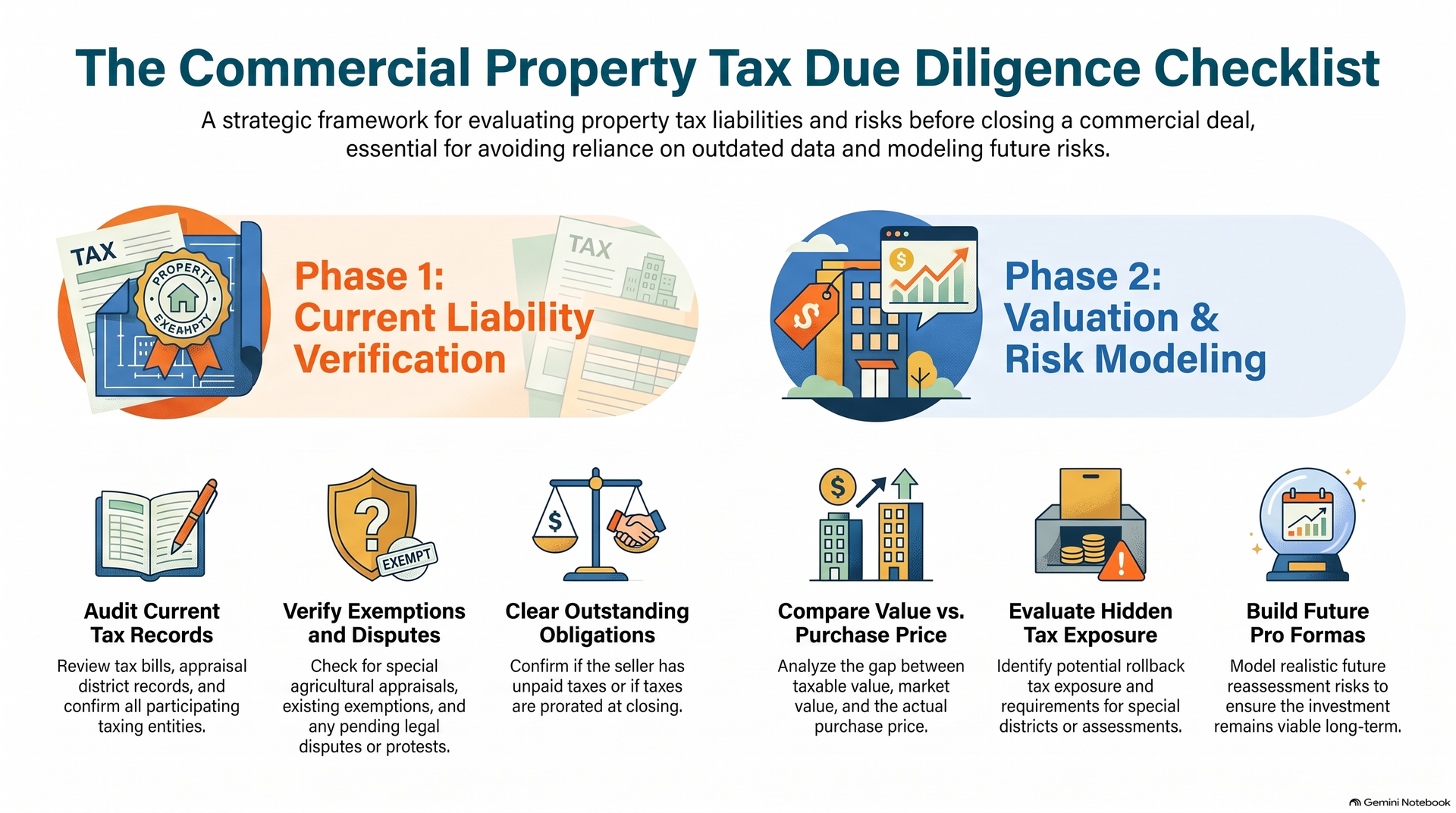
Property Tax Due Diligence Checklist
How Property Taxes Affect the Pro Forma
Property taxes should be modeled carefully in the acquisition pro forma.
If the tax estimate is too low, the buyer may overstate net operating income, cash flow, debt service coverage, cash-on-cash return, and future resale value.
Taxes may influence:
- Net operating income
- Operating expenses
- Tenant reimbursements
- Lease structure
- Debt service coverage
- Cash flow
- Cap rate analysis
- Development feasibility
- Exit value
- Investor returns
For triple-net or modified gross leases, buyers should also confirm how tax expenses are passed through to tenants. A tax increase may be reimbursable in some situations, but lease language determines what can actually be recovered.
Lease Review and Tax Reimbursements

For income-producing assets, the tax review should connect directly to the lease review.
Buyers should ask:
- Are tenants responsible for reimbursing property taxes?
- Is the lease triple-net, modified gross, or full-service gross?
- Are there caps on controllable or non-controllable expenses?
- Are tax increases fully recoverable?
- Are any tenants exempt from reimbursement?
- Are estimates reconciled annually?
- Do current reimbursements match the lease terms?
If tax increases cannot be passed through to tenants, the owner may absorb the additional cost. That can affect both cash flow and property value.
Reviewing a Commercial Property Tax Assessment
A commercial property tax assessment should be evaluated in the context of the full investment plan.
For example:
- A buyer purchasing below replacement cost may still face a higher future assessment.
- A developer changing agricultural land to commercial use may face rollback taxes.
- An investor buying a fully leased retail center may need to understand whether tenants reimburse tax increases.
- An owner-user may need to model future tax increases after improvements.
- A buyer acquiring land in a special district may face a higher long-term tax burden.
The assessment is not just a back-office detail. It can affect pricing, financing, annual cash flow, investment return, and exit strategy.
Questions Buyers Should Ask Before Closing

Before closing on commercial property in Texas, buyers should know the answers to questions like:
- What are the current property taxes?
- What is the current appraised value?
- How does the appraised value compare to the purchase price?
- What taxing entities apply to the property?
- Is the property located in a special district?
- Are there any special assessments?
- Are there exemptions or special appraisals?
- Will those exemptions continue after closing?
- Is there agricultural valuation?
- Could rollback taxes apply?
- Are taxes reimbursed by tenants?
- Are current tax assumptions realistic?
- What happens if the property is reassessed?
- How would higher taxes affect the pro forma?
- Does the exit strategy still work with a higher tax burden?
These questions can help buyers identify tax-related risks before they become post-closing surprises.
The Bottom Line
Commercial property taxes in Texas can significantly affect the real cost of ownership.
Before closing, buyers should review assessed value, tax districts, exemptions, rollback taxes, reassessment risk, special assessments, lease reimbursements, and pro forma assumptions. A property may look attractive at first glance, but the numbers can change if future taxes are not modeled correctly.
For investors, developers, and owner-users, property tax due diligence is an important part of evaluating commercial real estate in Texas.
CIP helps clients evaluate commercial properties, land opportunities, and investment strategies throughout Central Texas. Whether you are buying an income-producing asset, an owner-user property, or land for future development, understanding the tax picture early can help you make a more informed real estate decision before closing.
REQUEST YOUR CONSULTATION