May 29, 2026
Texas Data Centers Are Exploding: What This Means for Land Investors
For years, Texas has been known for oil, manufacturing, logistics, and industrial growth.
Now, another massive wave is building across the state:
Data centers.
And unlike some commercial real estate trends that come and go, this one is being fueled by something much bigger:
Artificial intelligence, cloud computing, and infrastructure demand.
The result?
Land that once seemed ordinary — especially land near major power infrastructure — is suddenly getting a lot more attention.
For Texas land investors, developers, and property owners, this shift matters.
A lot.
Why Data Centers Are Growing So Fast in Texas
The short version:
Every AI platform, cloud application, streaming service, online transaction, and enterprise system runs through physical infrastructure somewhere.
That infrastructure lives inside data centers.
And demand is exploding.
Texas has become one of the most attractive places in the country for large-scale data center development because it offers:
- Relatively affordable land
- Strong business climate
- Large infrastructure corridors
- Major population growth
- Access to energy and transmission systems
Texas also has another major advantage:
Room to expand.
Many other major markets are running into land constraints, power limitations, or regulatory slowdowns. Texas still has large-scale development opportunities available across multiple regions.
The Real Driver: Power
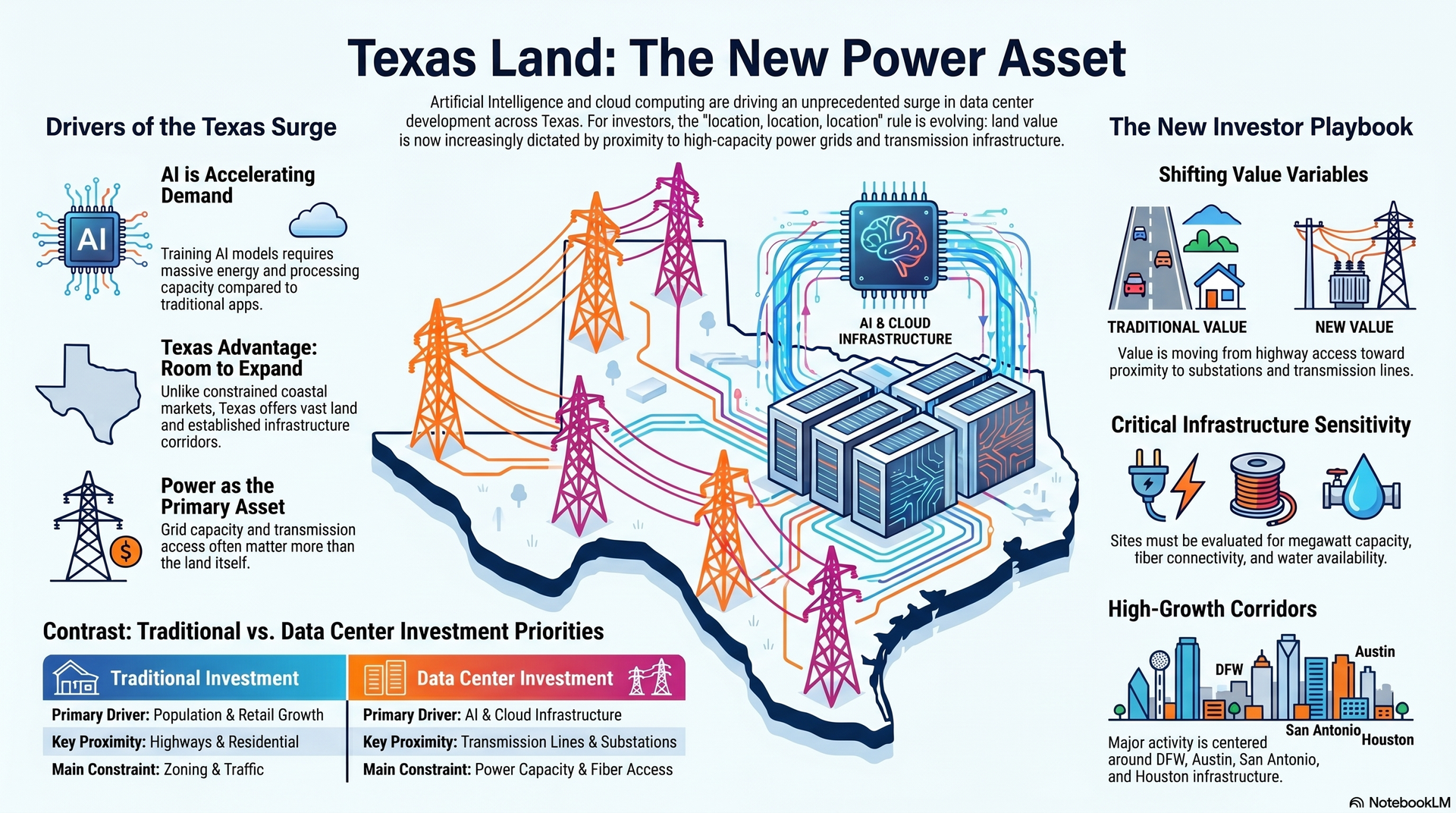
This is the part many landowners miss.
Data centers are not just looking for “land.”
They are looking for:
- Power access
- Transmission infrastructure
- Grid capacity
- Fiber connectivity
- Large contiguous sites
In many cases, power availability matters more than the land itself.
That means property located near:
- Transmission lines
- Substations
- Utility infrastructure
- Existing industrial corridors
can suddenly become significantly more valuable than surrounding land.
In today’s market, land near serious power infrastructure is starting to behave differently than traditional rural or industrial land.
For some properties, power access is becoming the asset.
AI Is Accelerating Everything
Artificial intelligence is dramatically increasing computing demand worldwide.
Training AI models and running AI systems requires enormous amounts of energy and processing capacity compared to traditional applications.
That’s pushing major technology companies, infrastructure groups, and developers to aggressively secure future data center locations now — not five years from now.
And Texas is directly benefiting from that race.
We’re seeing increased attention around:
- Dallas-Fort Worth
- Austin/San Antonio corridors
- Houston-area infrastructure
- Secondary industrial markets with available power capacity
This is no longer a niche asset class.
Data center development is becoming a major part of Texas commercial and industrial real estate conversations.
What This Means for Land Investors
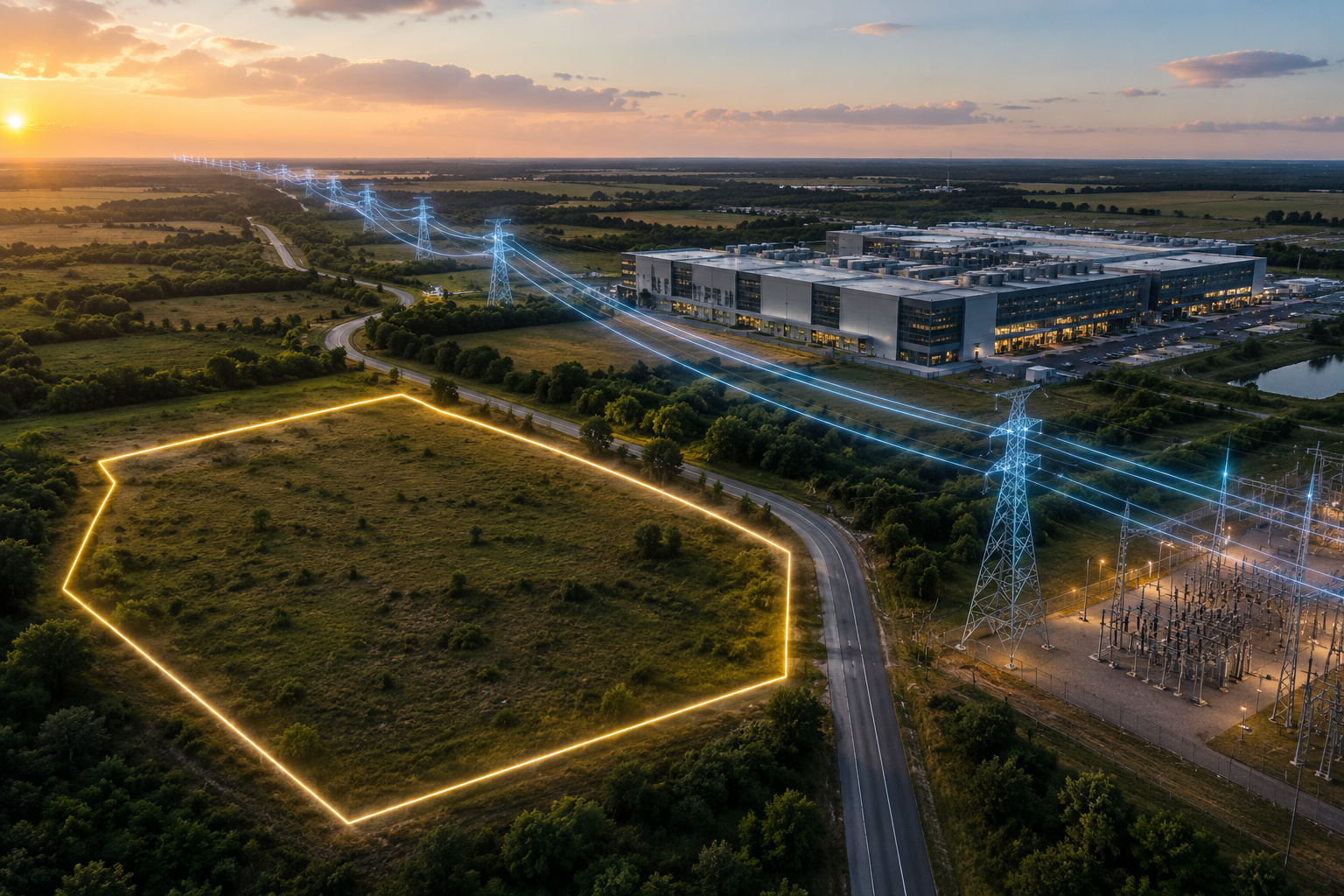
For land investors, the opportunity is not necessarily about building a data center yourself.
It’s about understanding how infrastructure demand changes land value.
Historically, investors focused heavily on:
- Highway access
- Population growth
- Retail expansion
- Residential development paths
Those still matter.
But now there’s another major variable entering the equation:
Energy infrastructure proximity.
Land near major transmission corridors or substations may become increasingly attractive to:
- Data center developers
- Industrial users
- Infrastructure groups
- Utility-driven projects
And once major infrastructure enters an area, nearby land values often begin moving differently as supporting development follows.
Not Every Property Benefits
This is important.
Simply owning acreage in Texas does not automatically make a property valuable for data center development.
These projects are extremely infrastructure-sensitive.
Developers are heavily evaluating:
- Available megawatt capacity
- Transmission accessibility
- Water availability
- Fiber connectivity
- Environmental conditions
- Entitlement timelines
In many cases, two nearby properties can have dramatically different values depending on utility access and development feasibility.
That’s why understanding infrastructure matters more than ever in today’s land market.
Industrial Real Estate Is Tied to This Too
This growth does not just impact raw land.
It also influences:
- Industrial development
- Utility expansion
- Warehouse demand
- Construction activity
- Service and infrastructure businesses
As data centers move into markets, surrounding commercial and industrial activity often follows.
This is one reason industrial real estate in Texas continues to remain strong despite broader market uncertainty in some sectors.
What Investors Should Be Watching Right Now
For investors looking long term, some of the biggest things to monitor include:
- ERCOT infrastructure expansion
- Transmission corridor growth
- Utility capacity announcements
- Large industrial project announcements
- AI infrastructure investments
- Fiber network expansion
In many cases, the land opportunities appear before the headlines fully catch up.
Final Thoughts
Texas is quickly becoming one of the most important data center and AI infrastructure markets in the country.
And while most people focus on the buildings themselves, experienced investors are paying attention to something even more important:
In this cycle, proximity to power, transmission, and infrastructure may become one of the biggest drivers of long-term land value growth across parts of Texas.
For the right properties, land near power is starting to look a lot like strategic infrastructure itself.
Looking at Land Opportunities in Texas?
At Commercial Industrial Properties (CIP Texas), we help investors, businesses, and landowners evaluate commercial and industrial opportunities across Texas markets.
Whether you’re analyzing development land, industrial property, or long-term investment opportunities, our team can help you understand how infrastructure trends are shaping the market.
REQUEST YOUR CONSULTATION